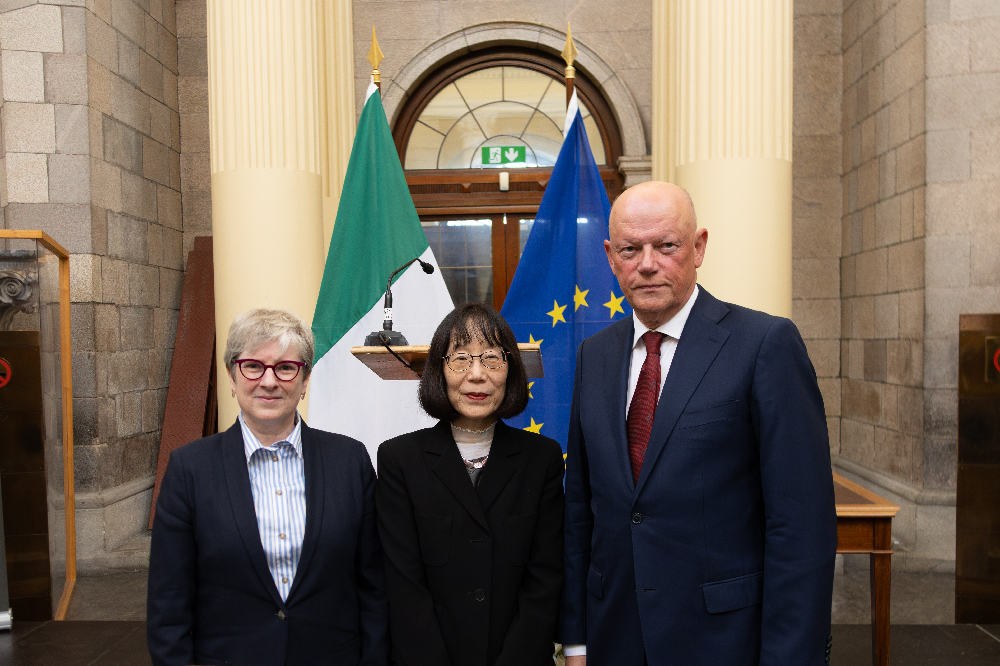
Judge Tomoko Akane, President International Criminal Court addresses the opening of the Legal Year 2026 Ceremony in the Four Courts
Judge Tomoko Akane, President International Criminal Court spoke of the importance of the rule of law, and the obstacles of sanctions by the US government on some its judges, Russia convicting some of its officials, and the interference of cyberattacks on its work. She said these were part of a broader assault against the rule of law.
“I represent a judicial institution that was created as a result of the historical sufferings that humankind has endured. In 1998, States gathered in Rome to create a permanent international criminal court that has jurisdiction over war crimes, crimes against humanity, and genocide, determined to put an end to impunity for these crimes.
Ireland upholds the rule of law to a remarkably high standard, and it has always been amongst the strongest supporters of the International Criminal Court ever since its inception in 2002
In the case of the ICC, we have faced several obstacles since our establishment, but this has intensified significantly during the last few years.
Today, the United States has sanctioned several ICC Judges and prosecutors, including myself, for carrying out their duties under the Rome Statute. Several current and former ICC officials have been convicted and sentence in absentia by Russia for their activities in relation to the situation in Ukraine, which again includes me.
At this moment, 12 of the 18 ICC Judges are the subject of at least one of these coercive measures. The institution also faces cyberattacks and other measures that are aimed at interfering with judicial proceedings and changing our course.
Such attacks against independent servants of the law are couched in narratives that are specific to the ICC and its activities, but they are also part of a broader assault against the rule of law.
It is of vital importance that courts, whether that is the ICC or any other court, remain independent and free from political pressure or any kind of coercion."
The Hon. Mr. Justice Donal O’Donnell, Chief Justice of Ireland
The Hon. Mr. Justice Donal O’Donnell, Chief Justice of Ireland said at the opening that he was: very grateful to President Akane for providing a first-hand view of the work of the International Criminal Court, and the difficult position the Court and its judges find themselves in, particularly because of the unjustified imposition of sanctions by the US upon judges, including Madame Akane as President. That provides a sobering reflection for all of us here.
He went on to say
"This brings into focus the importance of seeking to protect courts, judges and court systems against attack. That should not just be the concern of other judges, lawyers or NGOs operating in the justice sector – it should be the concern of anyone who wants to live in a free society that respects the individual and protects their rights And while the position in relation to the ICC is only the most recent and prominent example, it is only part of a wave of what is being properly and rightly called “rule of law backsliding”, but which involves a fundamental challenge to the post Second World War model of full adult franchise representative democracy, limited by a Constitution which alone, or together with other instruments, guarantees individual rights."
The Chief Justice went on to speak of Judicial appointments, remuneration, pension status, and the need for an independent advisory body on same. He spoke of security and the courts and the necessary resources needed for same, and of the willing ness of the judiciary to changer and their enthusiasm for ongoing learning.
Criminal legal aid
The Chief Justice said,
“It would be remiss of me on this occasion not to recognise that the is a long running dispute between solicitors on the criminal legal aid panel and the Department of Justice. Some issues relating to that are before the courts including the Supreme Court and that limits what I can say but I think I can say that the continuation of the dispute is a matter of concern to me and, I believe, judges generally I do hope the dispute can be brought to a conclusion soon”.
Supreme Court Judge, Ms Justice Aileen Donnelly , Chairperson of the Courts Service
Supreme Court Judge, Ms Justice Aileen Donnelly , Chairperson of the Courts Service at the opening ceremony highlighted several matters “because they demonstrate that administering justice fairly, equally and efficiently is literally built from the ground up. This is through the provision of accessible courtrooms where users can attend feeling confident that they know when and where their case will be heard while feeling assured that there are staff to assist them and that the judge has access to all relevant information about their case.
She said,
"Confidence in the public administration of justice is enhanced by governmental and legislative resourcing of the courts, through effective management of the courts, through the provision of information to the public on the functioning of the court system and of course through judges who act independently and impartially to uphold the laws”.
She pointed to several ongoing modernisation initiatives being pursued with energy by the Courts Service;
- In managing the courts, on the IT side the multi-year initiative to roll out a unified case management system across court jurisdictions, combined with increased investment in data capability, is incrementally improving and standardising our court processes while also increasing the quality and availability of data gathered from court activity. These advances are helping to improve operational, policy and resourcing decisions in the Courts Service and the wider Justice system.
- Beyond providing support services to judges in the usual ways by providing chambers, IT equipment and judicial assistants/researchers, there has been a further roll out of the Universal Case Management System for the judiciary. This has been a boon to judges who are starting to gain access to courts papers digitally and can see the progression of the case to date. The UCMS system also operates to the benefit of all court users.
Our approach to co-designing information and services with users in mind is making a difference. Within 100 days of the launch date, 45% of all grants of probate applications are being filed online by solicitors. The query rate on these applications has dropped by half with online applications being processed within 5 weeks.
- In providing information on the courts system our website has undergone significant changes and received positive feedback for its plain language approach and a 100% accessibility score from the National Disability Authority.
As part of our wider modernisation programme, revised District Court and Circuit Court forms have been developed in consultation with the judiciary, legal practitioners and other key stakeholders. The updated forms are intended to be clearer and more accessible, supporting greater consistency and a more user-focused court process.
Together, these initiatives demonstrate how the modernisation programme is translating into practical improvements in access, consistency and the administration of justice.
- In terms of the provision, management and maintenance of courts I am pleased to say that the tender evaluation process for the Family Courts building planned for Hammond Lane is progressing well, with the necessary approvals being secured, and work continues to advance the project towards contract award in the coming months.


